
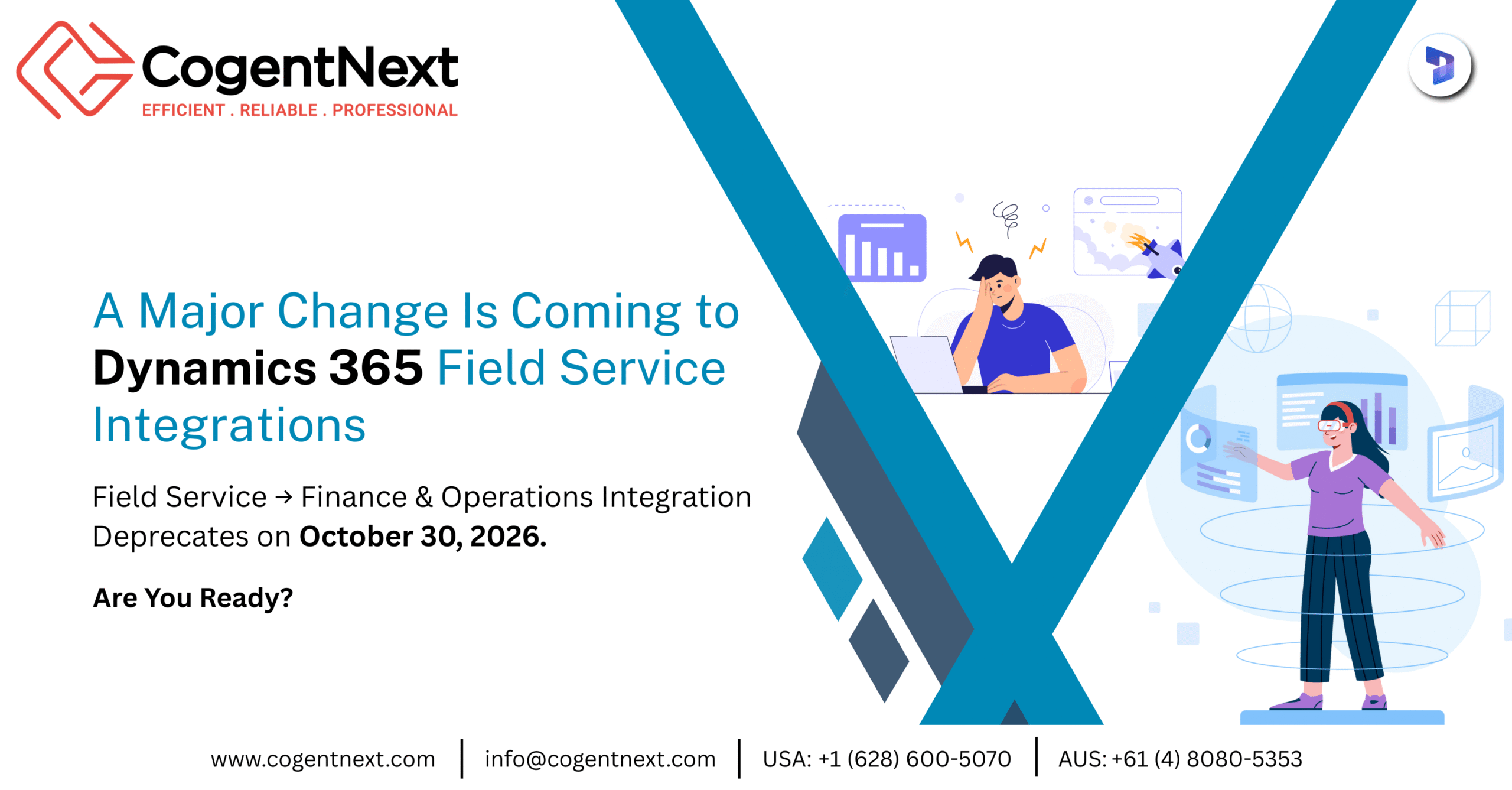
A Major Shift in Dynamics 365 Field Service Integrations — What It Means for Your Business and How CogentNext Helps You Prepare.
Digital ecosystems evolve, sometimes gradually, sometimes in sharp turns. Microsoft’s recent announcement marks one of those sharp turns that every Dynamics 365 Field Service customer needs to pay attention to.
Microsoft has officially confirmed the deprecation of the out-of-the-box Field Service integration with Finance & Operations applications, effective October 30, 2026. For many organizations, this integration has been the backbone connecting frontline service operations with financial, inventory, and asset management processes.
Its retirement signals more than a technical update as it represents a strategic redirection in how Microsoft envisions the future of service-centric operations.
So, what does this shift really mean?
Why is this
happening now?
And how do organizations
transition without disruption?
At CogentNext, we’ve been helping customers navigate transitions like these for years, and here’s our comprehensive breakdown of what’s changing, why it matters, and how you can prepare.
Why Microsoft Is Deprecating the Existing Integration
The legacy integration between Field Service and Finance & Operations (F&O) was functional, but not future-ready.
Microsoft’s shift is driven by three clear realities:
1. A Unified Service & Project-Centric Vision
The future of enterprise service management is not
just about work orders — it’s about connecting service
delivery with project planning, costing, billing, and
resource utilization.
Microsoft’s vision leans
toward a
Project Operations–driven architecture, enabling far more scalable and
predictable
financial processes.
2. Limitations in the Current Integration
The existing Field Service ↔ F&O pattern, while widely used, has:
- Rigid synchronization logic
- Limited extensibility
- Complex dependency chains
- Challenges with customization and scalability
These limitations become more evident as organizations increasingly demand real-time updates, cross-system intelligence, and automation.
3. A More Modern, Future-Proof Architecture
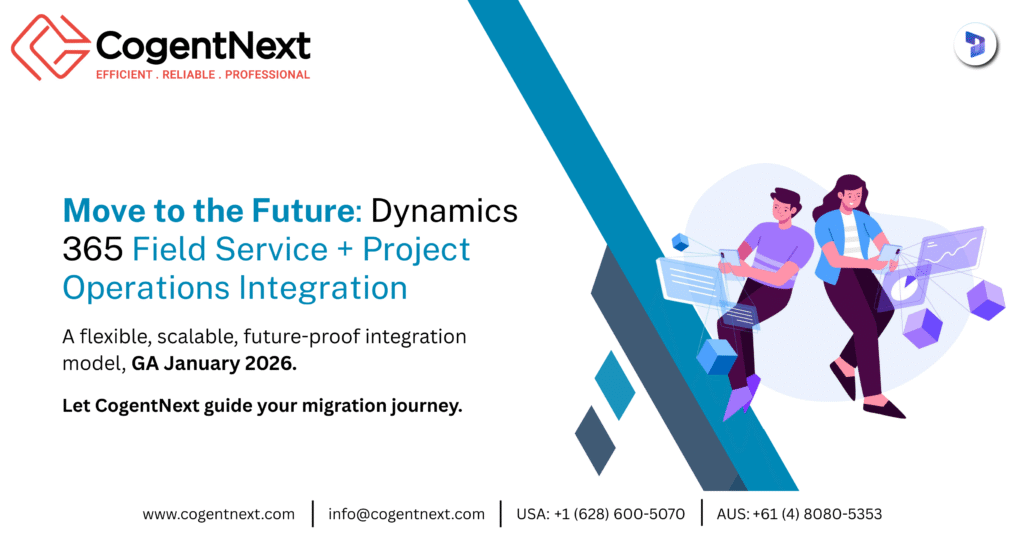
The new recommended model, integrating Dynamics 365 Field Service with Project Operations promises:
- Modern data flows
- Better lifecycle support
- Improved inventory and costing alignment
- More flexible integration patterns
- A foundation aligned with Microsoft’s long-term roadmap
This new pattern is set for General Availability in January 2026.
Why This Change Matters to You
If your organization relies on the current Field Service ↔ F&O integration, this shift affects key business processes:
✔ Work Order Lifecycle Management
Field technicians generate work orders that trigger financial and operational activities in F&O. After deprecation, this flow will not be supported natively.
✔ Asset, Inventory & Warehouse Synchronization
Many organizations depend on synchronized inventory between Field Service and F&O for parts usage, costing, and replenishment.
✔ Billing, Cost Accounting, and Financial Tracking
Service execution and financial outcomes are tightly connected. The current bridge supporting this will soon be retired.
✔ Long-Term Sustainability of Your Solution Architecture
A deprecated integration may continue to “work,” but it will:
- Receive no updates
- Pose increasing security risks
- Drift away from Microsoft’s roadmap
- Create technical debt that becomes costlier with time
In short: this change directly impacts your operational continuity, financial workflows, and long-term system stability.
The New Path Forward: Field Service + Project Operations
Microsoft’s recommended strategy is clear:
Move
from the legacy F&O integration to the
Field Service ↔ Project Operations
integration model.
What this new design enables:
- Unified visibility between service execution and project costing
- Streamlined time, expense, and billing flows
- More flexible handling of resources and inventory
- A modular architecture that aligns with the Power Platform
- Better lifecycle support and roadmap alignment
This isn’t just a replacement, it’s an evolution toward a more scalable, enterprise-grade service model.
What You Should Do Now — A Migration Plan from CogentNext
The sunset date — October 30, 2026 — may feel far away, but architectural migrations are never overnight activities. Early evaluation and planning are critical.
Here’s the strategic action plan we recommend to organizations:
1. Assess Your Current Integration Footprint
Understand exactly how the Field Service ↔ F&O integration supports your business:
- Which data entities are used?
- How critical are current sync jobs?
- What customizations sit on top of the existing integration?
- Which teams depend on the integrated flows?
CogentNext can help map your current architecture and identify risk areas.
2. Evaluate the Required Migration Efforts
We help you analyse:
- Data model differences
- Custom logic redesign requirements
- Inventory and asset sync impact
- Billing logic changes
- Project Operations licensing and configuration needs
A deep assessment prevents unpleasant surprises later.
3. Build a Roadmap for the New Integration Pattern
A future-proof migration roadmap should include:
- Gap analysis
- Pilot testing
- Coexistence strategy
- Custom extension planning
- Change management
- User readiness assessment
CogentNext designs migration roadmaps that prioritize continuity and minimize downtime.
4. Stay Connected to Microsoft’s Release Plans
The new integration is expected to become generally available in January 2026. Early adoption planning ensures you’re ready when it arrives.
5. Bring in Expert Guidance Early
This isn’t a simple plug-and-play switch. It’s a real architectural shift that touches:
- Field service operations
- Inventories
- Costing
- Billing
- Warehousing
- Financial processes
- Data flows
- Custom apps and automations
CogentNext’s Dynamics 365 experts can guide your organization through a safe and scalable transformation.
What Happens If You Do Nothing?
Organizations that delay planning could face:
- Unsupported integrations
- Growing instability
- Security risks
- Failure in critical sync jobs
- Inability to adopt new features
- Increased operational costs
- Emergency migration scenarios
The cost of emergency remediation is always far higher than the cost of planned transformation.
CogentNext: Your Partner in Navigating This Transition
At CogentNext Technologies, our mission is to help organizations evolve confidently with Microsoft’s changing ecosystem.
We offer:
- End-to-end Dynamics 365 consulting
- Migration assessments
- Architectural redesign
- Field Service and Project Operations expertise
- Integration and customization support
- Full implementation and managed services
Whether you’re evaluating, planning, or executing your migration, our team stands ready to support you.
Need Help Preparing for This Transition?
If your organization depends on the current integration and you want a smooth, confident transition:
Reach out to CogentNext
www.cogentnext.com
info@cogentnext.com
+1
(628) 600-5070, +91 98412 00746
Let’s ensure your Dynamics 365 ecosystem remains modern, stable, and future-ready.