
ERP in 2026: How Enterprises Can Prepare Today for Tomorrow’s Demands
As we move deeper into 2026, Enterprise Resource Planning (ERP) systems are no longer just operational backbones, they have become strategic engines for growth, intelligence, and resilience. Businesses across industries are rethinking how ERP supports decision-making, automation, compliance, and customer experience.
At CogentNext, a trusted implementation and development partner for Microsoft Dynamics 365, SAP, Oracle, and Salesforce ecosystems, we work closely with organizations to modernize, integrate, and future-proof their ERP environments. With our strong focus on AI-powered IT services and end-to-end enterprise integrations, we’ve seen firsthand how ERP platforms are evolving from rigid systems into intelligent, adaptive business platforms.
In this blog, we explore what ERP truly looks like in 2026, the key trends shaping its evolution, and the practical steps enterprises must take today to remain competitive tomorrow, regardless of size or industry.
The ERP Shift: From Transaction Processing to Intelligent Business Platforms
Traditional ERP systems were designed primarily for record-keeping, finance, inventory, procurement, and HR lived in separate modules with limited intelligence. In 2026, that model is obsolete.
Modern ERP platforms are now cloud-native, AI-enabled, and deeply interconnected, offering real-time visibility across the enterprise. They don’t just report what happened; they predict what will happen next and recommend actions to improve outcomes.
This transformation is driven by real-world pressures:
- Ongoing supply chain disruptions
- Rapid regulatory and compliance changes
- Sustainability and ESG mandates
- The demand for faster, data-driven decisions
Organizations still relying on legacy ERP systems often struggle with slow reporting, limited scalability, and manual processes. In contrast, enterprises adopting modern ERP platforms gain agility, automation, and intelligence that legacy systems simply cannot deliver.
The real question in 2026 is no longer “Should we modernize ERP?” but it’s “How fast can we do it without disrupting the business?”
Key ERP Trends Defining 2026
Based on industry shifts and our hands-on implementation experience at CogentNext, the following trends are actively shaping ERP adoption today.
1. AI-Driven Automation and Agentic Intelligence
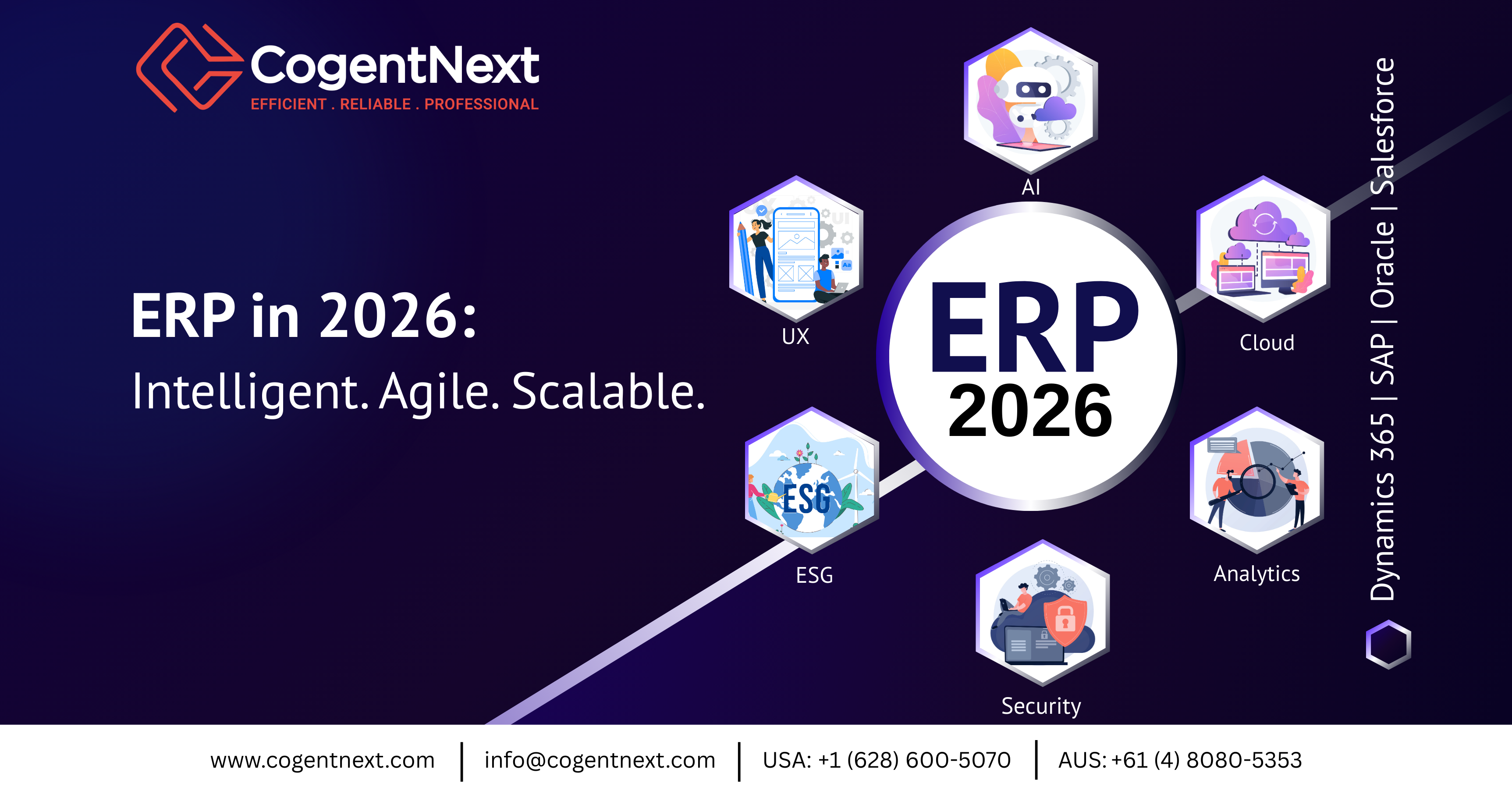
Artificial Intelligence has moved beyond dashboards and reports. In 2026, ERP systems are increasingly powered by agentic AI — intelligent agents that can act independently within defined business rules.
These AI-driven capabilities enable:
- Predictive demand and inventory planning
- Automated procurement recommendations
- Predictive maintenance in manufacturing
- Personalized customer insights in sales and service
At CogentNext, we integrate AI and machine learning across ERP platforms to help organizations reduce downtime, optimize costs, and respond proactively to disruptions. The foundation for success lies in clean, well-governed data, which allows AI models to deliver accurate, actionable insights.
2. Cloud-First and Composable ERP Architectures
By 2026, cloud ERP adoption is no longer optional. Enterprises are moving decisively toward hybrid and multi-cloud environments that provide flexibility, scalability, and lower infrastructure costs.
Composable ERP architectures are also gaining momentum. Instead of monolithic systems, organizations are adopting modular ERP components that can be assembled and extended as business needs evolve.
CogentNext supports cloud migrations and implementations across:
- Microsoft Dynamics 365
- SAP S/4HANA Cloud
- Oracle Fusion Cloud ERP
- Oracle NetSuite, often integrated with Salesforce for seamless CRM–ERP alignment
These platforms offer real-time collaboration, embedded analytics, automatic upgrades, and reduced IT overhead, enabling businesses to scale without complexity.
3. Sustainability and ESG Embedded into ERP
Sustainability is now a core ERP capability, not an afterthought. In 2026, ERP systems play a critical role in tracking:
- Carbon emissions
- Ethical sourcing
- Energy consumption
- Regulatory and ESG compliance
Industries such as manufacturing, logistics, and process industries are using ERP analytics to reduce waste, optimize resources, and meet global sustainability standards.
At CogentNext, we help organizations embed ESG reporting and compliance frameworks directly into their ERP environments, aligning operations with global mandates while improving transparency and accountability.
4. Advanced Cybersecurity and Data Governance
As ERP systems become more connected and data-rich, security and governance have taken center stage. Modern ERP platforms now include:
- AI-powered threat detection
- Role-based access controls
- Data encryption and compliance automation
- Secure cloud infrastructure
CogentNext ensures secure ERP implementations and migrations across Dynamics 365, SAP, Oracle, and NetSuite, leveraging enterprise-grade security architectures and best practices. Strong data governance is essential, especially with evolving regulations such as GDPR and emerging AI governance frameworks.
5. User-Centric Experiences and Real-Time Insights
ERP usability has dramatically improved in 2026. Modern platforms emphasize:
- Intuitive user interfaces
- Mobile accessibility
- Personalized dashboards
- Real-time analytics for business users
This shift democratizes data, enabling non-technical teams to access insights and act faster. At CogentNext, we customize ERP experiences to improve adoption, productivity, and decision-making across roles, from finance leaders to shop-floor managers.
What Enterprises Must Do Today
ERP transformation is not a one-time project, it’s a strategic journey. Here’s how enterprises can start preparing now, based on CogentNext’s proven approach.
1. Evaluate Your Current ERP Landscape
Assess scalability, integration capabilities, cloud readiness, and AI maturity. Many organizations discover hidden inefficiencies during this phase. CogentNext offers ERP assessments to identify gaps and define a clear modernization roadmap.
2. Invest in Skills and Change Management
Technology alone doesn’t guarantee success. User training and change management are critical. CogentNext provides tailored training programs across Microsoft, SAP, Oracle, Salesforce, and NetSuite environments to ensure smooth adoption.
3. Work with an Experienced ERP Partner
ERP modernization is complex. As a multi-platform ERP partner, CogentNext delivers end-to-end services, implementations, migrations, integrations, custom development, and AI enablement, aligned to industry-specific needs.
4. Adopt a Phased Modernization Strategy
Start with core modules, migrate to the cloud, and gradually introduce AI and advanced analytics. This phased approach minimizes risk while delivering measurable ROI at every stage.
5. Commit to Continuous Innovation
ERP systems must evolve alongside business needs. Regular optimization, feature enhancements, and performance tuning ensure long-term value and that’s where a long-term partner makes all the difference.
Conclusion: Future-Ready ERP Starts with CogentNext
In 2026, ERP is about empowerment, enabling enterprises to anticipate change, respond intelligently, and operate with confidence in a fast-moving digital world.
At CogentNext, we help organizations unlock the full potential of modern ERP platforms, including Microsoft Dynamics 365, SAP S/4HANA, Oracle Fusion Cloud ERP, Oracle NetSuite, and Salesforce-integrated ecosystems.
If you’re ready to modernize your ERP strategy and build a resilient, intelligent enterprise, now is the time.
Contact CogentNext today to start your ERP transformation journey.
Let’s shape the future of your business together.
info@cogentnext.com
www.cogentnext.com
USA: +1 (628) 600-5070
AUS: +61 (4) 8080-5353